5 Ways to Avoid Triggers on Your Dog's Walk Before You Even Leave the House
Five things you can check, prepare, and decide before you clip on the lead — for calmer walks with a reactive dog.
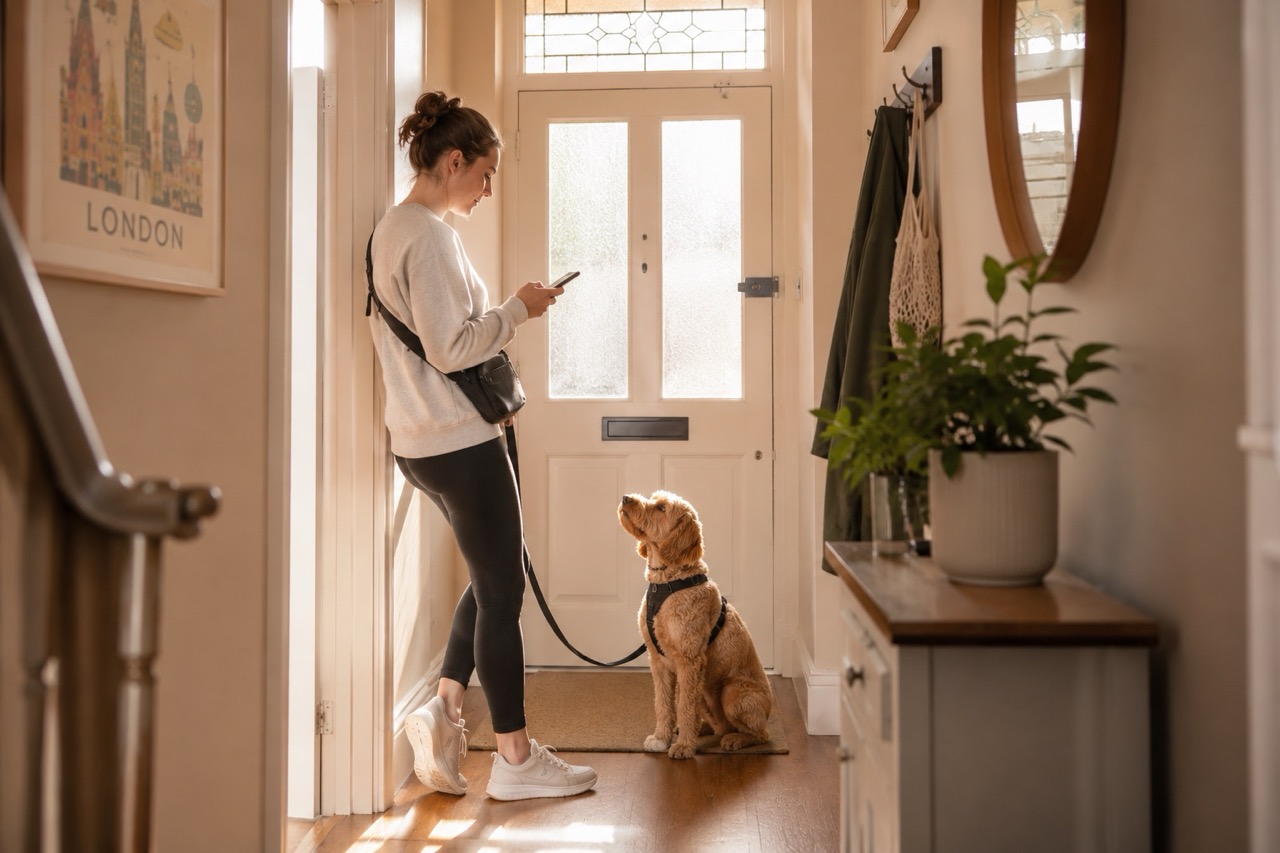
A reactive dog doesn't need a perfect walk. It needs a prepared one. The moments that tip your dog over threshold rarely happen by accident — they happen because something unexpected appeared at the wrong time, in the wrong place. Most of those surprises are preventable. Here are five things you can do to avoid triggers on your dog's walk before you've even clipped on the lead.
1. Check When Your Local Park Is Busiest — and Avoid Those Windows
This is the single most effective thing you can do. A quiet park at 7am and the same park at 5:30pm are two entirely different environments. Peak dog-walking hours in London typically cluster around 8–9am and 5–7pm on weekdays. Weekends are unpredictable from mid-morning onwards.
If you're walking a reactive dog in London, timing isn't a minor detail — it's the whole strategy. A park with three dogs scattered across it gives you space, sight lines, and room to manoeuvre. The same park with twenty dogs turns a walk into a gauntlet.
Some owners track this informally over weeks. Others use tools that show live park density before they leave. Paws Near Me does exactly this for Hackney parks — showing real-time busyness so you can pick your window rather than guess. If you're in the area, it's worth having on your phone.
But even without an app, keeping a rough mental log of when your local green space fills up will make a meaningful difference within a week.
2. Plan a Route That Gives You Options
Walking a reactive dog without a plan is stressful. Walking one with a fixed route that has no outs is worse. Before you go, think through your path in terms of space rather than distance.
What you're looking for:
- Width. Wide open spaces let you see dogs and people approaching from a distance, giving you time to increase the gap or change direction calmly.
- Alternative exits. Know at least two ways to leave any area you're entering. If something appears ahead, you want to be able to turn without drama.
- Buffer zones. Identify spots along your route — a bench tucked behind a hedge, a corner with a low wall — where you can step aside and let something pass.
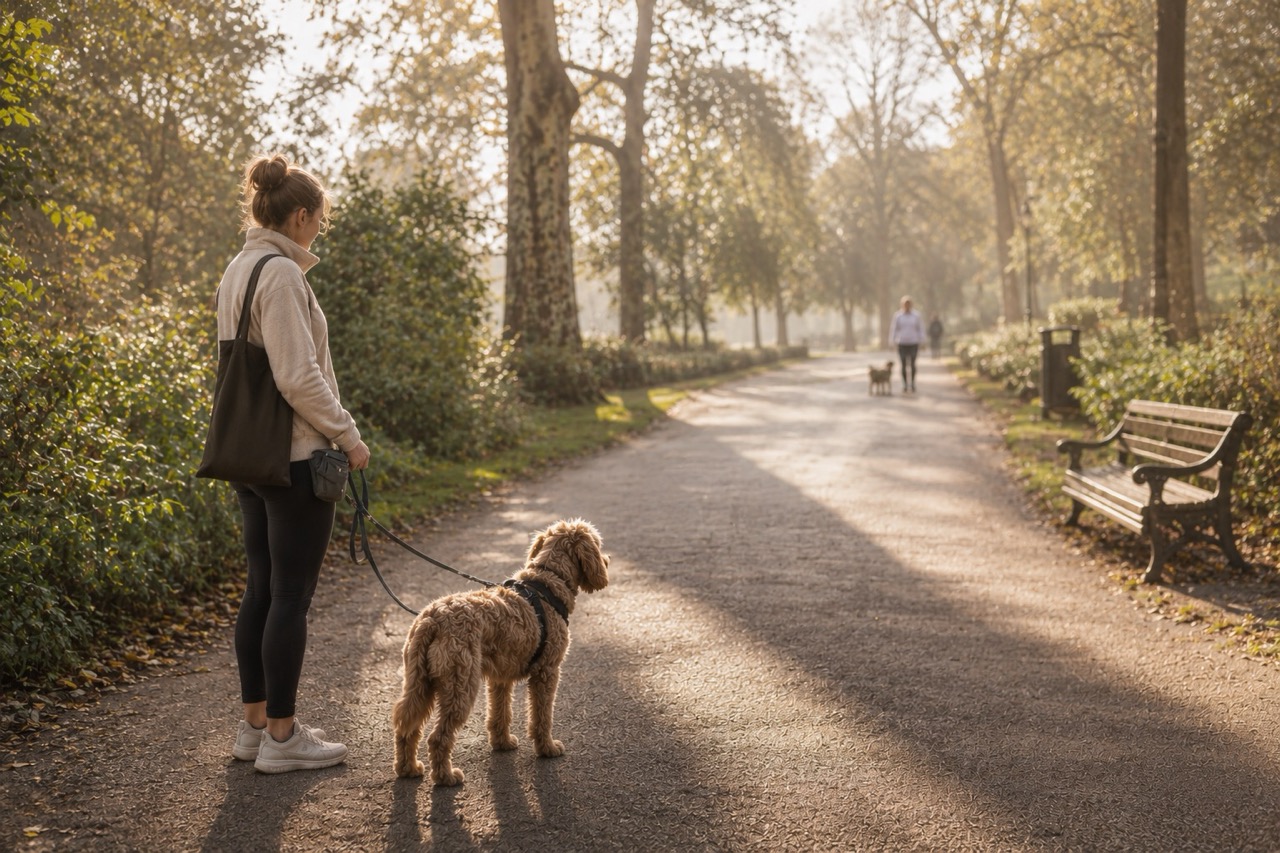
In practice, this usually means walking the perimeter of a park rather than through the middle, using tree lines as visual barriers, and avoiding pinch points like narrow gates at busy times.
Choosing the right route through a busy city park is a skill that builds with repetition — but having a rough plan before you leave removes a lot of the in-the-moment decision-making that makes reactive dog walks exhausting.
3. Know Your Dog's Specific Triggers — Not Just "Other Dogs"
Reactive dogs get lumped together, but their triggers vary enormously. Some react to other dogs on-lead but are fine off-lead. Some lose it around cyclists, skateboards, or toddlers. Others only react to dogs of a specific size or posture — a stiff, direct approach sets them off where a bouncy, loose dog does not.
Spend a few minutes before your walk thinking about what you're likely to encounter on this particular route, at this particular time. A path alongside a cycle lane carries a different risk profile to a route through a quiet residential square.
The Dogs Trust guidance on reactivity is useful here — it helps owners distinguish between fear-based reactivity, frustration-based reactivity, and predatory responses, each of which calls for a different management approach. Once you know what you're specifically dealing with, you can build your route around it rather than trying to guard against everything at once.
4. Sort Your Gear Before You're at the Door
Equipment makes a real difference to how a reactive dog walks — and sorting it out on the pavement with a dog that's already clocked a squirrel is not the moment.
A well-fitted front-clip harness gives you more directional control without putting pressure on the neck, which can escalate arousal in reactive dogs. A double-ended lead clipped to both the front ring and a back ring gives you steering without any sudden jerking. Check the fit at home: you should be able to slip two fingers under any strap, and nothing should twist or ride up when the dog moves.
Also worth prepping: a treat pouch loaded and clipped on, not buried in a bag. High-value treats — real meat, cheese, something your dog genuinely works for — not dry kibble. You want to be able to reward a calm response within a second or two of it happening. That window closes fast.
Lay it all out the night before if that helps. Faffing at the door raises your stress levels, which your dog reads before you've left the house.
5. Do a 60-Second Check-In With Yourself
This one gets skipped constantly, and it's probably the most important.
Your dog is already reading you before the walk starts. If you leave anxious about what might happen — tense on the lead before anything has occurred, scanning every corner for threats — your dog feels all of that. It primes them. You arrive at the park already halfway to threshold, together.
Before you leave, take a few slow breaths. Slow your pace. Hold the lead loosely. Remind yourself that you have a plan, you've chosen a good time window, and you know your exits. That mental reset changes how you carry yourself — and how your dog interprets the walk before it's even begun.
The Blue Cross guidance on reactive dogs covers this owner-side piece well, and is worth bookmarking if you're still building confidence with the approach.
Preparation Is Part of the Walk
For reactive dog owners, the walk doesn't start at the park gate — it starts at home. Timing, route, knowledge of your dog's specific triggers, the right gear, and your own mental state are all within your control before you've taken a single step outside.
Get those five things right consistently, and the walk itself becomes manageable. Finding the quiet windows in your local park is part of the same preparation — the more you know before you leave, the less you're improvising once you're out there. Not every walk will be smooth. But the ones that aren't won't catch you unprepared.